29 October 2026
What is sport and exercise medicine? A UK guide
 Dr Isa WaheedStudySEM Founder13 min read
Sport and exercise medicine (SEM) is the medical specialty that looks after the health of people who are physically active, and of people who need to become more active. It covers musculoskeletal (MSK) injuries and conditions, the use of exercise to prevent and treat disease, and the medical care of athletes and teams, from someone doing their first parkrun to a Premier League footballer.
You will also hear it called sports medicine or sports and exercise medicine, and SEM doctors are often called sports physicians or sports medicine doctors. They all describe the same specialty.
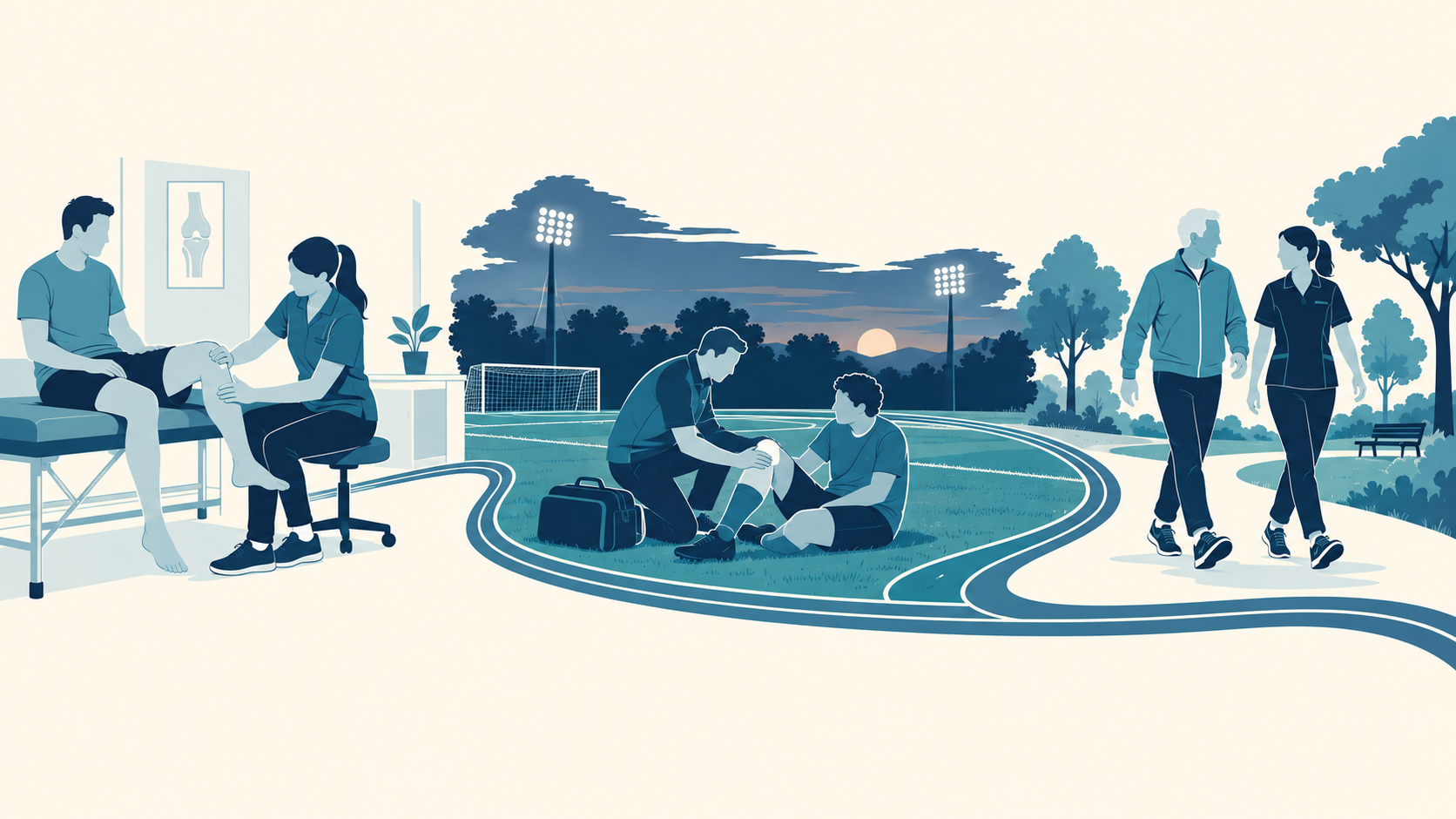
Most people picture a sports medicine doctor sprinting onto a pitch with a medical bag. That does happen, but it is a small part of the job. Most SEM doctors spend far more of their week in clinic than pitchside, and plenty of their patients have never played competitive sport.
I have been working my way towards a career in SEM since medical school, so this is the explanation I wish someone had given me at the start: what the specialty involves, why it exists, the jobs it leads to in the NHS and privately, and how it is growing in the UK and around the world.
What does a sport and exercise medicine doctor do?
SEM is usually split into 3 broad areas, which is also how the Faculty of Sport and Exercise Medicine (FSEM) organises its diploma exams:
- MSK medicine: diagnosing and managing musculoskeletal injuries and disease, both acute and chronic, from muscle and ligament injuries to tendinopathy, bone stress injuries and osteoarthritis
- Team care: looking after athletes and teams, including pitchside and event medicine, concussion, illness and the medical side of keeping athletes training and competing
- Exercise medicine: using exercise and physical activity to treat chronic diseases such as type 2 diabetes, heart disease and depression, and to prevent disease and injury in the first place
Alongside these, SEM doctors carry out procedures. These can include steroid injections, joint aspiration, orthobiologics such as platelet-rich plasma (PRP), shockwave therapy and needle procedures such as barbotage. Many SEM doctors also use ultrasound in clinic, both to help make a diagnosis and to guide some of those procedures.
The common thread is looking at the whole person and what they want to get back to. A hamstring injury in a footballer is a tissue problem, but it is also a question about training load, recovery, previous injuries and when the player can safely return. The same thinking applies to a 60-year-old who wants to get back to tennis after a knee problem.
Do sports medicine doctors do surgery?
No, SEM is a medical specialty, so SEM doctors do not operate. The hands-on side of the job is examination and procedures such as injections and shockwave therapy. If someone needs an operation, such as an anterior cruciate ligament (ACL) reconstruction, the SEM doctor refers them to an orthopaedic surgeon and often stays involved in their rehabilitation and return to sport.
Sports surgery is a separate career, reached through orthopaedic surgical training. This is one of the most common points of confusion about the specialty, so it is worth being clear on early if you are deciding between the two.
Is sports medicine only for athletes?
No, and elite athletes make up a small share of the patients most SEM doctors see. A typical NHS SEM clinic might include a runner with Achilles pain, a teenager with knee pain linked to growth, an office worker with a stubborn shoulder problem, and someone with type 2 diabetes who has been told to exercise more but does not know where to start.
That breadth is why the specialty is called sport and exercise medicine. The exercise half matters every bit as much as the sport half.
Why does sport and exercise medicine exist?
Sports medicine has been around in the UK for a long time. BASEM, the British Association of Sport and Exercise Medicine, was founded in 1952 as the British Association of Sports Medicine. SEM only gained formal specialty status in 2005, in the run-up to the London 2012 Olympics.
The case for making it a specialty comes down to physical activity. Being active lowers the risk of many long-term conditions and helps treat them, yet FSEM points out that exercise medicine has had no consistent teaching in medical schools or postgraduate training.
The scale of the problem is large. According to the World Health Organization, nearly a third of adults worldwide, around 1.8 billion people, did not get enough physical activity in 2022, and that figure is projected to reach 35% by 2030 if current trends continue. Inactivity raises the risk of heart disease, stroke, type 2 diabetes, dementia and several cancers.
SEM tackles that from both ends: keeping active people healthy enough to keep moving, and helping inactive people become active safely.
Where do SEM doctors work?
Most SEM consultants have a portfolio career, splitting their week across several settings rather than working in one place. That flexibility is one of the best things about the specialty, and it is also why no two SEM jobs look quite the same.
NHS and public sector roles
- NHS SEM and MSK clinics, in hospitals or the community, seeing sports injuries, tendon problems, joint pain and complex musculoskeletal cases, often including diagnostic ultrasound and procedures
- MSK interface and triage services, which sit between GP and hospital care and decide who needs imaging, injections, physiotherapy or a surgical opinion
- Exercise medicine clinics, which some services run to help people with long-term conditions exercise safely
- Military sports and exercise medicine, through the Defence Medical Services
- Public health and physical activity promotion
- Academic and teaching roles, including at universities and the National Centre for Sport and Exercise Medicine, set up as a legacy of London 2012
Sport and private roles
- Sports teams in any sport and at any level, from grassroots and academy sides to professional clubs, with roles ranging from casual matchday cover to full-time head of medical services (see How much do football doctors earn in the UK? for what those roles pay in football)
- Individual athletes, in sports such as tennis, golf, athletics and swimming
- National teams and governing bodies, including the English Institute of Sport, which supports Olympic and Paralympic athletes
- Event medicine, covering marathons, triathlons, cycling events, combat sports and motorsport, much of it sessional and some of it voluntary (I wrote about volunteering as a doctor at the London Marathon)
- Private SEM clinics, offering sports injury assessment, injections, orthobiologics, shockwave therapy and second opinions
- Consultancy, advising sports organisations, governing bodies and companies on areas such as athlete health, medical policy and sports technology
What a portfolio week can look like
Every SEM consultant's week is different, but to give you a feel for it, a portfolio week might look something like this:
- Monday and Tuesday: NHS SEM clinic, including injections and other procedures
- Wednesday: an exercise medicine clinic, teaching or research
- Thursday: private clinic
- Friday: a medical day at a club, reviewing injured players and planning rehabilitation with the physios
- Saturday: matchday cover
The balance shifts with each person's interests, seniority and life outside work.
Can you work in SEM without being an SEM consultant?
Yes, and plenty of people do. Formal SEM training is small: in the 2025 recruitment round, 107 doctors applied for 12 national training posts. The specialty reaches well beyond consultants, though.
- GPs can develop an extended role in MSK medicine, and since 2026 FSEM has offered a formal GP with Extended Role (GPwER) accreditation in MSK medicine
- Many club doctors in English professional football are GPs with additional SEM qualifications
- Doctors from emergency medicine and other specialties provide pitchside and event cover, usually with a qualification such as Advanced Trauma Medical Management in Football (ATMMiF)
- Physiotherapists, nurses, paramedics, sports scientists, strength and conditioning coaches, nutritionists and psychologists all work in SEM, and the FSEM diplomas in MSK medicine and exercise medicine are open to many of them
If you want the full route to becoming an SEM consultant, I covered it in How to become a sport and exercise medicine doctor in the UK. For a first-hand account of landing early sports roles, Dr Zohaib Shaikh's Breaking into SEM is worth a read.
How is SEM different from physiotherapy, orthopaedics and rheumatology?
These 4 roles overlap a lot, which is where much of the confusion comes from. Here is the short version.
| Role | Training | Main focus | Do they operate? |
|---|---|---|---|
| SEM doctor | Doctor with specialist SEM training | Diagnosis and non-surgical management of musculoskeletal problems, exercise medicine and athlete health | No |
| Physiotherapist | Registered allied health professional | Assessment and rehabilitation through exercise, movement and manual therapy | No |
| Orthopaedic surgeon | Doctor with surgical training | Surgical and non-surgical care of bones, joints and soft tissues | Yes |
| Rheumatologist | Doctor with specialist medical training | Inflammatory and autoimmune joint and connective tissue disease | No |
SEM doctors and physios in practice
The biggest overlap in that table is between SEM doctors and physios, so it is worth unpacking.
A physio's core skill is rehabilitation: restoring movement, strength and function through exercise, manual therapy and education, usually over a course of sessions. In a club, the physio is often the person an injured athlete sees most.
An SEM doctor's core skill is medical decision-making. That means making a diagnosis that takes in the whole body, including problems that turn out not to be musculoskeletal at all, deciding which investigations are needed and interpreting them, prescribing, carrying out procedures, and managing medical problems in athletes, from illness and asthma to concussion. In professional football, the doctor usually carries overall clinical responsibility while the physios lead the day-to-day rehabilitation.
In practice the 2 work side by side, and many injured athletes will see both.
Are physios taking over SEM?
It is a fair question if you are thinking about the specialty, because physiotherapy roles have expanded a lot. Advanced practice physiotherapists now:
- See patients as the first point of contact for MSK problems in many GP surgeries
- Assess, diagnose and request imaging
- Give injections, and some carry out MSK ultrasound
- In some cases, prescribe independently
- Hold consultant physiotherapist posts in the NHS
So some work that used to sit only with doctors is now shared, which often means patients are seen sooner. I do not think it puts SEM at risk, though:
- SEM goes well beyond MSK: team care involves medical emergencies, illness and concussion, and exercise medicine often means managing people with complex chronic disease
- Medical training comes into its own when a case is complex or uncertain, such as pain that turns out to be inflammatory, infective, referred or sinister, or symptoms that cross several body systems
- Some roles require a doctor: from League Two upwards in English football, a GMC-registered doctor must be present at every home match
- Demand is rising on both sides, with more people needing help to become active and competition for SEM training rising sharply since 2018
The way I see it, the future is teams where physios and doctors each work at the top of their training. If you are going into SEM, the best response is to build the parts of the job that rely most on medical training.
SEM around the world
Sport and exercise medicine is organised very differently from country to country, which is worth knowing if you ever want to work abroad.
- In Australia and New Zealand, sport and exercise physicians train through the Australasian College of Sport and Exercise Physicians
- In the Netherlands, sports physicians (sportartsen) have their own specialist training and registration, and the national congress runs its scientific programme in English for an international audience
- In Italy, competitive athletes have had to undergo pre-participation screening, including an ECG, since 1982
- In the United States, sports medicine is a subspecialty that doctors enter through a fellowship after training in a field such as family medicine, internal medicine, emergency medicine or paediatrics
- South Africa has established SEM as a recognised specialty too
- In the Gulf, investment has been heavy: Aspetar in Qatar is a specialist orthopaedic and sports medicine hospital and FIFA Medical Centre of Excellence, and Saudi clubs have been actively recruiting sports medicine doctors
The international conference circuit gives a sense of the scale. The Isokinetic football medicine conference drew more than 2,500 delegates from 80 countries in 2024.
Is SEM growing in the UK?
Yes, and there are several clear signs:
- Competition for training has more than tripled, from around 2.7 applicants per post in 2018 to 8.9 in 2025
- FSEM passed 1,000 members in 2025
- FSEM launched a formal GP with Extended Role accreditation in MSK medicine in 2026
- FSEM and BASEM are merging to form a single College of Sport, Exercise and Musculoskeletal Medicine (CSEM), with an ambition to seek a Royal Charter
With inactivity rising and more people wanting to stay active for longer, demand for doctors who understand both sport and exercise as medicine looks set to keep growing.
The honest picture
I think SEM is one of the most rewarding paths in medicine, but it is worth going in with your eyes open.
The good parts:
- Huge variety, and a career you can shape around your own interests
- A rare mix of preventing disease and treating it
- Working closely with physios, coaches and sports scientists
- The chance to combine NHS work with sport
The less glamorous parts:
- Training posts are scarce and competition is fierce
- Early sports work is often unpaid or poorly paid
- Working in sport means evenings, weekends and time away
- Most of the job happens in clinic rather than pitchside
Where to start
- If you are a medical student, read How to get into sport and exercise medicine as a medical student
- If you are a doctor thinking about specialty training, start with How to become a sport and exercise medicine doctor in the UK, then How to build a competitive portfolio for SEM ST3 training
- If you are a physio or another health professional, look at the FSEM diploma exams
- For exercise medicine, FSEM's Moving Medicine is free and well worth exploring
If you want to learn the clinical side properly, StudySEM's topic library covers the whole SEM curriculum, with every topic readable through a doctor, physio or student lens.
Quick answers
What is the difference between sports medicine and sport and exercise medicine? In the UK they usually mean the same thing. Sport and exercise medicine is the official name of the specialty, and it makes clear that exercise as a treatment is part of the job alongside sport.
What conditions does a sports medicine doctor treat? Mainly musculoskeletal injuries and pain, such as tendinopathy, muscle and ligament injuries, bone stress injuries and joint pain, plus concussion, athlete health problems and long-term conditions where exercise is part of the treatment.
How long does it take to become an SEM consultant in the UK? At least 8 to 9 years after medical school: 2 foundation years, 2 to 3 years of core training, then 4 years of SEM specialty training from ST3 to ST6. Many people take longer.
Is SEM training competitive? Yes: in the 2025 recruitment round, 107 doctors applied for 12 national training posts, a ratio of almost 9 to 1.
Can physiotherapists work in sports medicine? Yes, physiotherapists are central to SEM and work in clubs, private clinics and NHS sports injury services. They can also sit the FSEM diplomas in MSK medicine and exercise medicine.
Will physiotherapists replace sports medicine doctors? Physiotherapy roles have expanded into first-contact assessment, injections and ultrasound, but SEM also covers team care, exercise medicine and complex medical decisions that rely on medical training. The 2 professions increasingly work side by side.
How much do sports medicine doctors earn? SEM consultants in the NHS are paid on the national consultant pay scale, and earnings beyond that vary widely with private practice and sports work. For football specifically, see How much do football doctors earn in the UK?
Which organisations represent SEM in the UK? FSEM sets training and exam standards, and BASEM is the main membership organisation. The two are merging to form the College of Sport, Exercise and Musculoskeletal Medicine (CSEM), so names may have changed by the time you read this.