What you are actually working towards
Before deciding what to do, it helps to understand what you are eventually being scored on.
A quick note before we go further. The scoring criteria I refer to are based on the framework published by Physician Higher Specialty Training (PHST) at the time of writing. These criteria are reviewed and can change between recruitment rounds. Before you plan anything around them, check the current self-assessment scoring framework on the PHST website. Everything below is accurate as of publication, but the PHST site is always the authority.
SEM is a Group 2 specialty, meaning you enter higher specialty training at ST3 after completing foundation training and one of three core training routes: Internal Medicine Training, Acute Care Common Stem, or GP Specialty Training. I compared those routes in detail in How to become a sport and exercise medicine doctor in the UK, so I will not repeat it here.
Applications go through Oriel. The process has two stages.
Stage one is shortlisting. You complete a self-assessment scoring yourself across seven domains, worth 38 points in total, plus 2 marks for how well you organise your evidence. Separately, two independent assessors each award you up to 10 points for commitment to the specialty, giving 20 more marks. Commitment alone accounts for a third of your shortlisting score.
Stage two is interview. Your application score is halved and carried forward, so 40 becomes 20 out of 100. The interview itself carries the other 80 marks, and the suitability and commitment station is the single most heavily weighted part of it.
The competition is significant and has been tightening for years. In the 2025 round, 107 doctors applied for 12 posts nationally, and that ratio shows no sign of easing as awareness of the specialty grows faster than training posts are created.
I wrote a full breakdown of every scoring domain in How to build a competitive portfolio for SEM ST3 training. If you want the complete picture, read that afterwards. What follows is the medical student version.
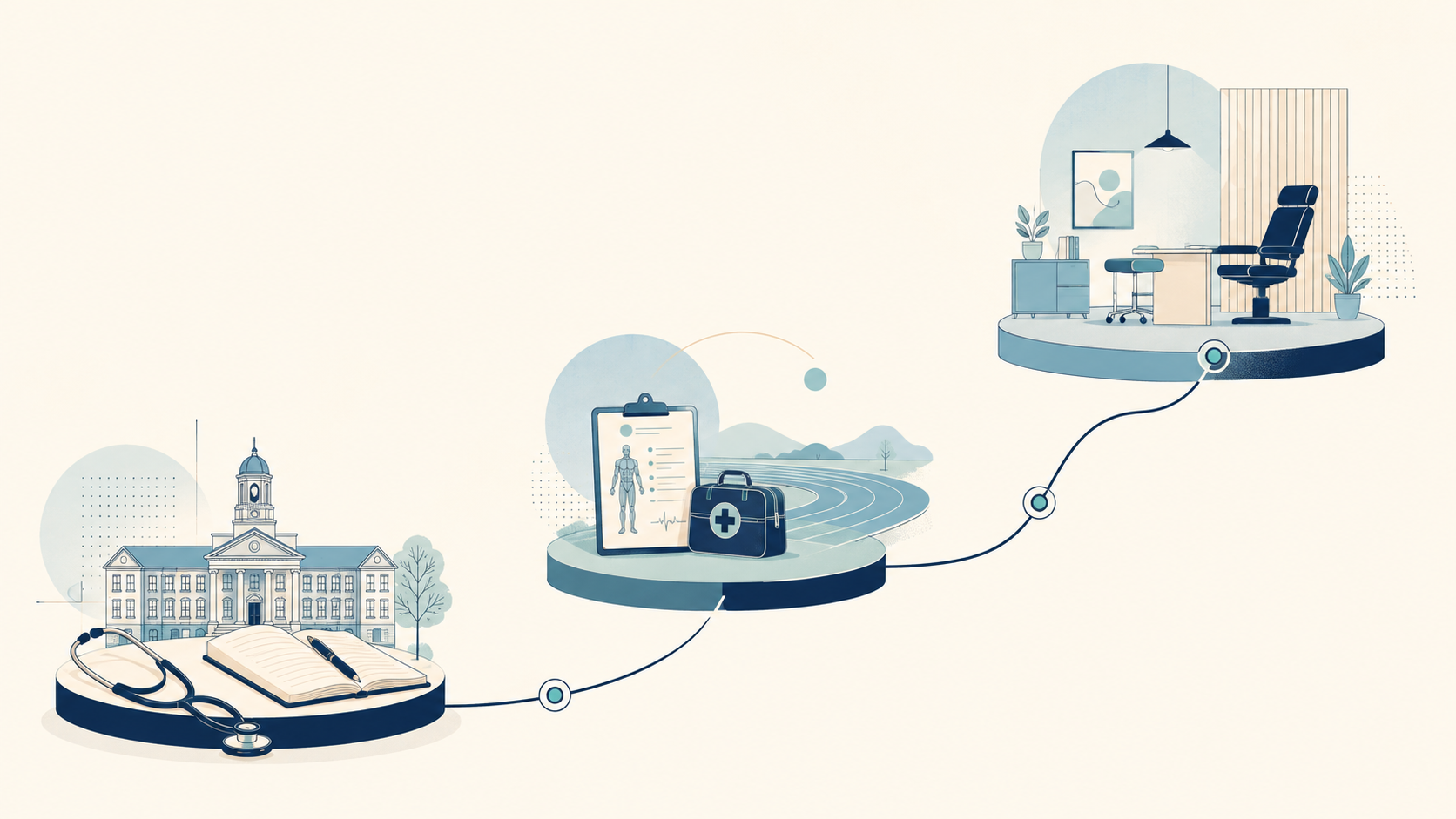
Why start now rather than later
Starting early does more for you than simply accumulating points sooner, although that is part of it.
You can bank portfolio points early. Some of the highest-scoring domains, publications and presentations especially, do not care when you achieved them. A first-author paper published in your fourth year of medical school scores exactly the same as one published in your third year of GP training. Getting them done early means you are not trying to write a systematic review while also sitting MRCP.
You build a track record rather than a scramble. Commitment to specialty is scored on the range and consistency of what you have done. Assessors can tell the difference between someone who has been engaged with SEM for six years and someone who spent the last eight months assembling a portfolio. The first tells a coherent story, the second reads like a checklist completed under time pressure.
You generate things to talk about. Interviews are won on specifics. A candidate who can describe a particular case they saw shadowing an SEM consultant, or a problem they encountered covering a mass participation event, is far more compelling than one who can only say they find the specialty interesting.
You build a network while it is easy. Medical students get away with asking for things that feel awkward later. Emailing a consultant to ask if you can shadow them is completely normal as a student, whereas doing it as an ST1 carries different expectations. Use that window. The people you meet now become your supervisors, collaborators, and referees later.
You find out whether you actually want it. This one matters most. SEM looks glamorous from the outside, and the reality involves a lot of NHS MSK clinic, a lot of unpaid weekend event cover before anyone pays you, and a training pathway that takes at least nine years from graduation. It is far better to discover early whether that appeals to you than to build a portfolio towards a career you do not want.
There is a sixth, quieter reason. Almost everything below makes you a better doctor regardless of where you end up. Learning to prescribe exercise, recognise a sick athlete, or manage an acute injury on a pitch will serve you in general practice, emergency medicine, rheumatology, or anywhere else you land.
The single easiest thing you can do is put yourself where SEM people are.
Join or start a SEM society at your university. Many medical schools have one, and if yours does not, start it. I founded the society at my own university, and it is still running today, which has been one of the more satisfying things to watch from a distance. Founding a society and running it for a year gives you organisational experience, a legitimate reason to invite speakers, which is how you meet consultants, and something concrete to point to on an application. If one already exists, get on the committee rather than just attending.
Get involved with USEMS. The Undergraduate Sport and Exercise Medicine Society is the national body for students interested in the specialty. They run conferences, events, and a committee that students can apply to join. I sat on the USEMS committee for two years and it was one of the more useful things I did, mostly because of who it put me in a room with. National committee roles also demonstrate initiative in a way that purely local involvement does not.
Become a BASEM member and an FSEM affiliate. Both offer student rates and both are worth having. BASEM in particular runs the major UK SEM conference each year and offers student poster competitions, which is a low-barrier route to your first presentation. Note that FSEM and BASEM are progressing towards merging into the College of Sport, Exercise and Musculoskeletal Medicine, so the names and structures may have changed by the time you read this.
Go to conferences and talks. The BASEM annual conference is the obvious one. Beyond that, the Institute of Sport, Exercise and Health runs a regular programme of talks and lectures, many of them free. Collect certificates for everything, because you will need them later and reconstructing attendance from memory is painful.
Use LinkedIn properly. This feels like career advice from a different decade, but SEM is a small specialty and a great deal of it lives on LinkedIn. Post about what you are doing, engage genuinely with people working in the field, and connect with speakers after events. Not performatively, and not with generic congratulations on every post, just be visible and interested. A surprising number of opportunities in this specialty come through people recognising your name.
Building knowledge and hands-on experience
Community gets you access. This is what you do with it.
Arrange an elective or placement somewhere serious. FIFA has Medical Centres of Excellence around the world, and they are worth approaching directly for electives, student selected components, or summer placements. So are NHS SEM services, professional club medical departments, and university sports medicine clinics. Prepare yourself for the fact that a lot of them will simply ignore your email, which is normal and not a reflection on you. Send more than you think you need to, and start early, because the ones that do say yes often come with paperwork, insurance, and visa arrangements that take months to work through.
Do the FIFA Diploma in Football Medicine. It is free, entirely online, and covers 42 modules across the breadth of football medicine. It costs you nothing but time, it gives you a certificate, and it genuinely teaches you things. There is no reason not to do this.
Consider the BASEM Foundation Skills Course. A three and a half day residential course covering the breadth of SEM, from physical activity and physiology through to MSK examination, concussion, and rehabilitation. It is open to medical students provided you have the background to benefit from it. It costs money, so treat it as an investment rather than an obligation, but it gives you a broad grounding in the specialty in a short space of time.
If football interests you, do the FA Introduction to First Aid in Football. Online, self-paced, and certified for three years. You cannot do the higher-level pitchside qualifications until you are a registered doctor, but this is the sensible entry point.
Work for a first aid cover company. This is the one I would push hardest. Several companies provide medical cover at sporting and public events and take on medical students as first aiders. You get paid, which matters as a student, and you get hands-on experience managing real presentations in the exact environment SEM doctors work in. I did this throughout medical school and it taught me more about event medicine than any course could, as well as giving me a much clearer sense of whether I actually enjoyed the work.
Starting your portfolio properly
Now the points. Here is what is realistically achievable while you are still a student.
Publications: 8 points
This is the highest-scoring domain you can realistically complete at medical school. Maximum marks require first author, joint-first author, or corresponding author on a PubMed-cited original research publication. Systematic reviews count as original research, and they are the most accessible route because you do not need a lab, a patient cohort, or ethics approval.
There are two ways in. Either run one yourself as a student selected component or intercalated project and push it through to publication, or approach SEM clinicians and academics, particularly those at universities or in NHS SEM services, and ask whether you can contribute to existing projects. The second route requires you to be proactive and to accept that most emails go unanswered. Send them anyway. If you are running your own, skip the meta-analysis, since it adds statistical complexity and delay without changing your score. Register your protocol on PROSPERO and follow the PRISMA guidelines.
Presentations: 6 points
Maximum marks need an oral presentation at a national or international meeting where you are first or second author. Here is the efficiency play: once you have a publication, submit the same work as an abstract to a national or international conference. Many accept submissions with a fee. One project, two high-scoring domains, 14 points. Your university may fund conference attendance, and it is worth asking about sponsorship before assuming you cannot afford it. I won a BASEM sponsorship as a student which covered my travel and ticket costs, and I would not have gone otherwise.
Training in teaching: 3 points
A PG Certificate or PG Diploma in medical education scores full marks. You can apply in your final year once you have passed finals, which means starting it immediately after graduation rather than trying to fit it around foundation training. If you are genuinely interested in education, choose a course you will enjoy. If you are doing it purely for the points, find the cheapest accredited online option and complete it, because the score does not differentiate between programmes.
Teaching experience: 5 points
Often overlooked by students, but peer teaching programmes are exactly what this domain describes. Organise a series of sessions for students in the years below, run it over three months or more, collect formal feedback with a simple Google Form, and get a letter from a supervising tutor confirming your role. This is very achievable at medical school and a lot of people leave it until much later than they need to.
One thing to get right about intercalation
An intercalated BSc or MSc in sport and exercise medicine is a genuinely good thing to do. I did the one at Queen Mary and it was excellent. Be clear about what it does and does not give you, though. Under the current framework, intercalated degrees cannot be scored in the postgraduate qualifications domain, regardless of the level awarded. So intercalate for the knowledge, the research supervision, the contacts, and the project that becomes your publication, rather than for portfolio points, and plan for a standalone masters later if you want that domain filled.
A realistic order of operations
You do not need to do everything. If I were starting again, this is roughly how I would sequence it.
Early years: join your SEM society and USEMS, take out student BASEM and FSEM membership, do the FIFA diploma, start working event cover with a first aid company.
Middle years: intercalate if it suits you, start a research project with publication as the explicit goal, organise a peer teaching programme, go to your first BASEM conference.
Final years: publish, present the same work at a national conference, arrange an elective somewhere that stretches you, apply for a PG Cert once finals are passed.
Throughout all of it, keep every certificate, every letter, and every piece of feedback in one folder. The candidates who score best on evidence organisation are the ones who have been collecting as they go, rather than reconstructing it the week before the deadline.
None of this is complicated. It is simply early, and that is the whole advantage available to you right now in a way it will not be in five years.
 Dr Isa WaheedStudySEM Founder10 min read