25 May 2026
How much do football doctors earn in the UK?
 Dr Isa WaheedStudySEM Founder10 min read
Every doctor who has ever thought about working in football has wondered the same thing. How much does it actually pay?
It is one of the questions doctors interested in sport and exercise medicine ask most often, and traditionally one of the hardest to get a straight answer to. Salary information in football medicine has always felt like something of an industry secret. Roles are rarely advertised publicly. Pay is negotiated behind closed doors. Most doctors working in the game started out in unpaid or voluntary roles and worked their way up slowly. Networking helps, particularly for positions that are never formally advertised, but the typical entry point is putting in time on the sidelines for free before any paid opportunity comes along. The whole point of this article is to break that down, share real figures, and make this information freely available to anyone considering the path.
The answer depends on where you sit in the football pyramid, what your job title is, whether you are full-time or covering the odd Saturday, and how much leverage your qualifications and reputation give you. The range is enormous. A casual matchday doctor at a League Two academy might take home less than the cost of their professional indemnity. A Head of Sports Medicine at a top Premier League club could earn over half a million pounds a year.
Most of the salary data in this article comes from The Nxt Level Group's UK Football Salary Benchmarking report for 2024-25, which is based on their work placing candidates across English professional football. I have supplemented it with publicly available job adverts, regulatory documents, and what I know from colleagues working at various levels of the game.
Who needs a doctor and who does not
Not every football club in England has a doctor. At the bottom of the pyramid, non-league clubs may have no medical professional at all beyond a first aider. As you move up through the National League system, the standard of medical provision expected increases, but it is not always mandated in the way you might assume.
From Step 3 of the National League upward, clubs are expected to have at least someone trained in pitchside emergency care, typically through courses like the ATMMiF (Acute Trauma Management in Football) programme. But at this level, that person is often a physiotherapist or sports therapist rather than a doctor. A simple first aider is not sufficient. The expectation is for someone who can deliver intermediate life support skills at a minimum.
At Steps 1 and 2 of the National League, a higher standard of medical provision is expected. Having a doctor present at home matches is considered best practice, though not always strictly mandatory. Many clubs at this level rely on local GPs who do it part-time, often for modest fees.
The real regulatory line sits at League Two and above. From League Two through the Championship and into the Premier League, the EFL and FA mandate that a GMC-registered medical practitioner must be present at all home matches. For any Team Doctor appointed after 1 July 2003, there is an additional requirement: they must hold a recognised Diploma in Sports Medicine or equivalent qualification.
At the European level, UEFA's Club Licensing Regulations (Article 37) require that clubs applying for a UEFA licence appoint at least one doctor responsible for the medical support of the first squad during matches and training, as well as doping prevention activities.
What the roles look like at each level
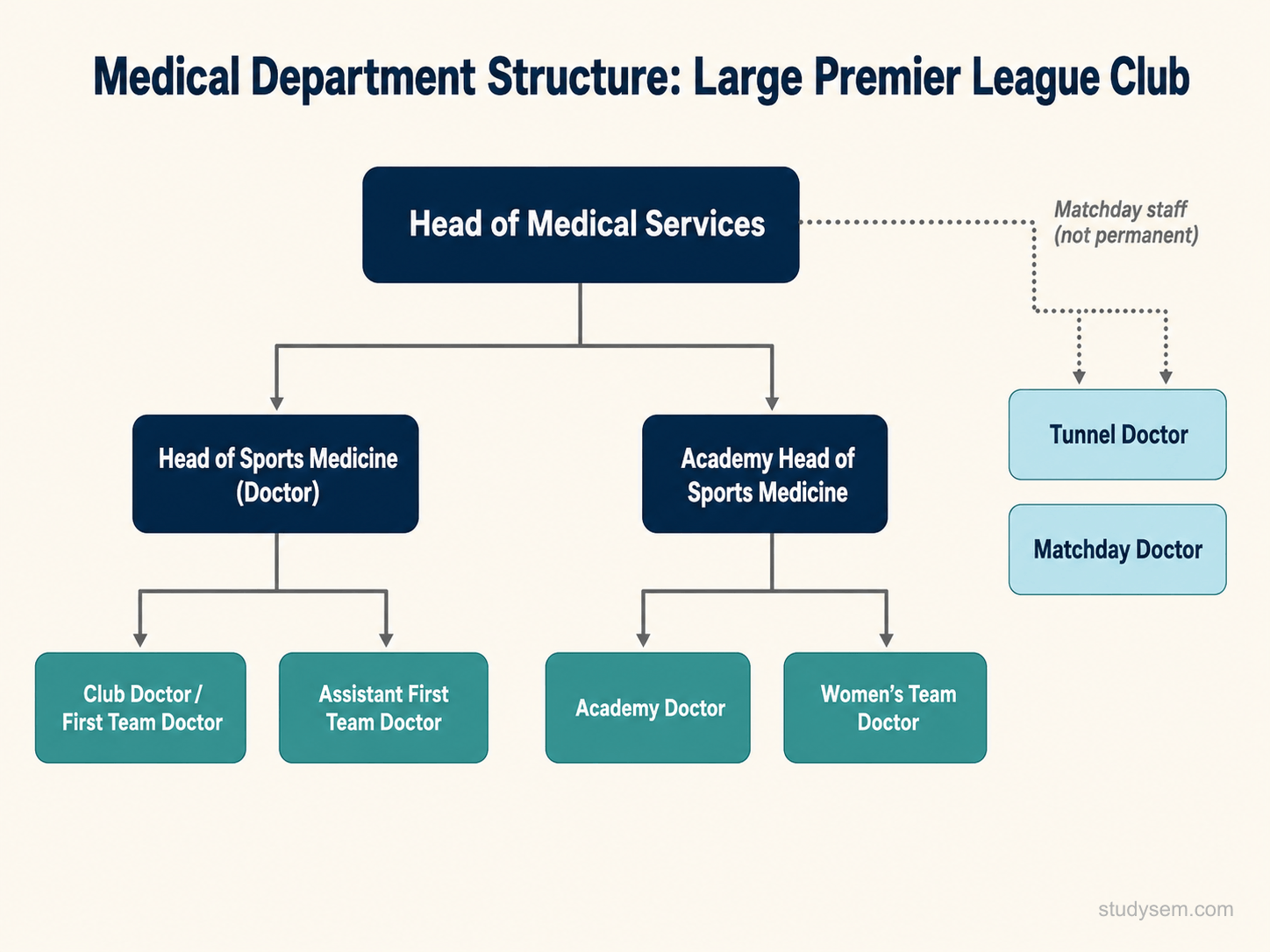
The structure of a medical department varies wildly depending on the size and budget of the club.
At a lower EFL club, you might find one doctor covering everything. Training sessions, home matchdays, away travel, pre-season medicals, pre-signing assessments, and ad hoc clinic time. This is often a part-time arrangement. The doctor might be a local GP with a Diploma in Sport and Exercise Medicine, fitting the football work around their regular practice.
A Championship club in the middle of the table typically has a small medical team. One Club Doctor (possibly part-time), a Head Physiotherapist, one or two additional physios, and perhaps a sports scientist. The doctor carries overall clinical responsibility but the physio team handles the day-to-day rehabilitation work. Research published in sports medicine journals has found that the majority of club doctors in English professional football are GPs with additional SEM qualifications, and that many were appointed through personal contacts rather than formal job adverts. Time commitments at this level vary from full-time to just a few hours per week.
At Premier League level, it is a different world entirely. Recent regulations now mandate that Premier League clubs appoint a full-time Club Doctor. SEM specialisation is strongly preferred. Large clubs do not stop at one doctor. A well-resourced Premier League medical department might include a Head of Medical Services (overseeing everything), a Head of Sports Medicine (doctor), a First Team or Club Doctor, an Assistant First Team Doctor, an Academy Head of Sports Medicine, one or more Academy Doctors, a Women's Team Doctor, a Tunnel Doctor, and additional matchday medical staff.
The Head of Medical Services at this level is not really a clinical role in the traditional sense. It is a leadership and governance position. They manage budgets, hire and supervise the medical and science teams, liaise with the board and coaching staff, and carry overall clinical accountability for every player on the books.
The salary figures
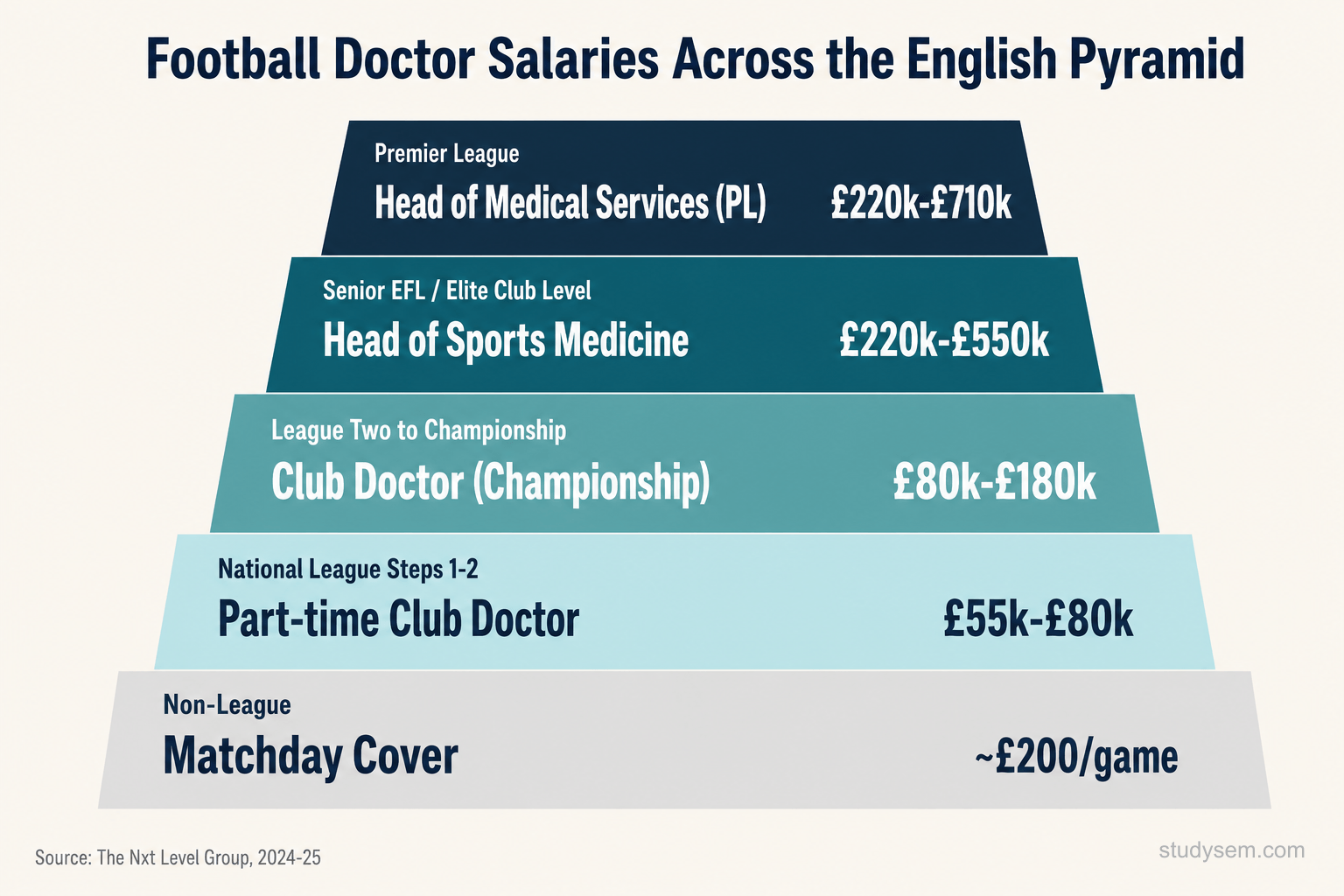
Here is where it gets interesting. These ranges are drawn primarily from The Nxt Level Group's 2024-25 benchmarking data, covering the Premier League and Championship. I have added context from job adverts and industry knowledge where relevant.
Head of Medical Services (Premier League): £220,000 to £710,000. This is the most senior medical position at a club. The wide range reflects the enormous variation in club size, budget, and how much operational scope the role carries. At the top end, this person oversees a department of 15 to 20 staff and reports directly to the board.
Head of Sports Medicine, Doctor (Premier League): £220,000 to £550,000. Often the most senior doctor at the club in clinical terms. In the Championship, the equivalent role sits at roughly £140,000 to £220,000, and the report notes this bracket also aligns with what GPs in football tend to earn at that level.
Club Doctor or First Team Doctor (Premier League): £200,000 to £400,000. This is the role most people think of when they picture a "football doctor." You are at every match, every training session, responsible for all medical treatments, injury rehabilitation oversight, pre-signing medical protocols, and coordination with external consultants. In the Championship, the range drops to roughly £80,000 to £180,000, and the position is frequently part-time.
To put that Championship figure in concrete terms: when Millwall FC formally advertised for a part-time First Team Club Doctor in late July 2024, the salary was openly benchmarked at £55,000 to £60,000 per year.
Academy Head of Sports Medicine (Premier League): £70,000 to £190,000. This is a relatively new role within the industry. Many clubs have only recently formalised it as a distinct position. The report notes that these roles are often filled by internal promotion, with existing staff taking on significantly more responsibility without a proportionate salary increase.
Casual matchday cover (lower leagues and academies): Around £200 per game. This is the reality for many doctors getting their first exposure to football. You turn up on a Saturday, cover the match, and go home. The problem is professional indemnity insurance, which runs at roughly £400 to £600 per month for this kind of work. If you are covering one or two matches a month, the maths does not work. You may barely break even, or run at a loss. Most doctors at this level do it because they love football, want experience on their CV, or hope to build a relationship with a club that could lead to something bigger.
What the money actually buys you
The headline figures at Premier League level look impressive. And they are. But there is a reason turnover in these roles is not as low as you might expect, and why some of the most experienced football doctors in the country end up choosing to leave.
Working as a football club doctor can feel like a 24/7 commitment. Players call with concerns outside of training hours. Pre-season tours run through what would normally be your annual leave. European fixtures add midweek travel on top of a weekend match schedule. You travel with the team to every away fixture, every pre-season tour, every cup replay. In the early days, that feels like a dream. You are pitchside at Anfield, in the tunnel at the Bernabeu, on the team bus after a cup final. But for doctors with partners, children, or any life outside the club, the lack of flexibility and predictability grinds. You do not choose your schedule. The fixture list does, and it does not care about your daughter's school play.
The environment is also nothing like the NHS. Football comes with big personalities, intense media scrutiny, and political dynamics that most doctors have never encountered in a clinical setting. Agents calling about scan results. Managers asking why a player is not fit. Stories in the press about injuries you have not disclosed. You are not the most important person in the room. In a hospital, a consultant is the boss. At a football club, you answer to the manager, the sporting director, sometimes directly to the owner. The hierarchy can feel uncomfortable for doctors used to being at the top of the clinical pecking order.
There are genuine conflicts of interest too. A manager wants a key player available for a must-win match. You have clinical concerns about their hamstring. The pressure to clear players before they are ready is real, even if it is rarely stated outright. Navigating that takes a specific kind of temperament, and not every good doctor has it.
The pay, some would argue, does not always reflect the demands. A Premier League Club Doctor earning £250,000 sounds like a lot, and it is. But broken down by the hours worked, the lack of autonomy over your own diary, and the stress of operating in an environment where one wrong decision can make the back pages, it starts to look different. A doctor on £200,000 working 70 to 80 hour weeks (including international travel, evening player calls, and constant phone availability) is often earning a lower true hourly rate than a standard locum registrar or an established GP partner.
Why many leave for private practice
And then there is the exit that many experienced football doctors eventually take. After building a reputation over several years at a club, many pivot to private sports medicine clinics. The reasons are straightforward: better work-life balance, more predictable hours, greater clinical autonomy, and often significantly more money.
It is not unusual for a well-known football doctor to move to a private clinic paying twice the salary for half the weekly hours. The prestige of the Premier League opens doors in private practice in a way that few other career paths can. Patients and referrers recognise the name, trust the background, and are willing to pay accordingly. The clinic is where many of the best football doctors eventually choose to build the next phase of their career.
A closing note on the wider market
It is worth watching what is happening internationally. It is not just footballers being recruited to the Saudi Pro League. Sports medicine doctor positions are actively being filled there too, with higher base salaries and significantly lower personal tax rates than the UK.
This is no longer a hypothetical trend. Aramco-backed clubs like Al-Qadsiah have been aggressively recruiting Western-trained medical staff, including advertising for elite Academy Medical Doctors to lead their youth high-performance setups. Executive search firms like MRG Global are routinely handling specialised sports medicine placements out of Riyadh. Current executive briefs for roles such as Medical Director of Elite Sports Medicine and Performance list tax-free packages scaling from roughly 560,000 to over 930,000 SAR, which translates to approximately £120,000 to £200,000 or more, net of tax. For context, a UK doctor earning £200,000 gross takes home considerably less after income tax and National Insurance.
Saudi Arabia's Vision 2030 programme is driving rapid investment in sports infrastructure across the board, and the demand for experienced, English-speaking sports medicine doctors is growing fast. Whether that becomes a significant pull factor for UK-based football doctors remains to be seen. But the option is increasingly on the table, and for doctors weighing up their next move, the conversation is no longer limited to which English club or clinic to join.
Salary data referenced in this article is drawn primarily from The Nxt Level Group's UK Football Salary Benchmarking 2024-25 report. Regulatory references are based on FA Medical Regulations, EFL match-day requirements, and UEFA Club Licensing Regulations (Article 37) as understood at the time of writing. Individual salaries vary significantly by club, contract structure, and individual negotiation.
Dr Isa Waheed - Founder, StudySEM
Sign up free to keep reading
Create a free StudySEM account to read this article in full and get the weekly newsletter for UK SEM clinicians.
Sign up free + get the weekly newsletterAlready have an account? Log in
- Free account, no card
- Every gated insight
- 10 full topics, yours for life
- Weekly newsletter