28 June 2026
How to volunteer as a doctor at the London Marathon
 Dr Isa WaheedStudySEM Founder7 min read
I volunteered as a doctor at the 2026 TCS London Marathon. It was my first time. This is what it was actually like, how I got involved, and what you should know if you are thinking about doing it yourself.
How I got involved
London Marathon Events (LME) recruit volunteer doctors through their own medical team. I heard about it through my MSc in Sport, Exercise and Health at UCL, where LME put out a call for doctor volunteers. You sign up through an online portal, submit your credentials, and wait for approval.
The requirements are straightforward: you need to be a doctor with full GMC registration, ideally ST2 or above for indemnity purposes, and hold a valid DBS check. LME cover you for indemnity on the day but advise having your own cover as well. You can still help in non-clinical roles if you do not meet the clinical threshold. Medical students, for example, can volunteer in assistive roles.
I applied around two months before the event. If you are interested, reach out to the LME medical team at medadmin@londonmarathonevents.co.uk a couple of months ahead of the next marathon. Once accepted, you receive a medical information pack and logistics briefing, and you join a large online medical briefing a few days before the event.
It is worth being clear about one thing: this is entirely voluntary. You are not paid. You give up your whole day, and the only compensation is experience, a jacket, and the knowledge that you were useful.
Where you end up
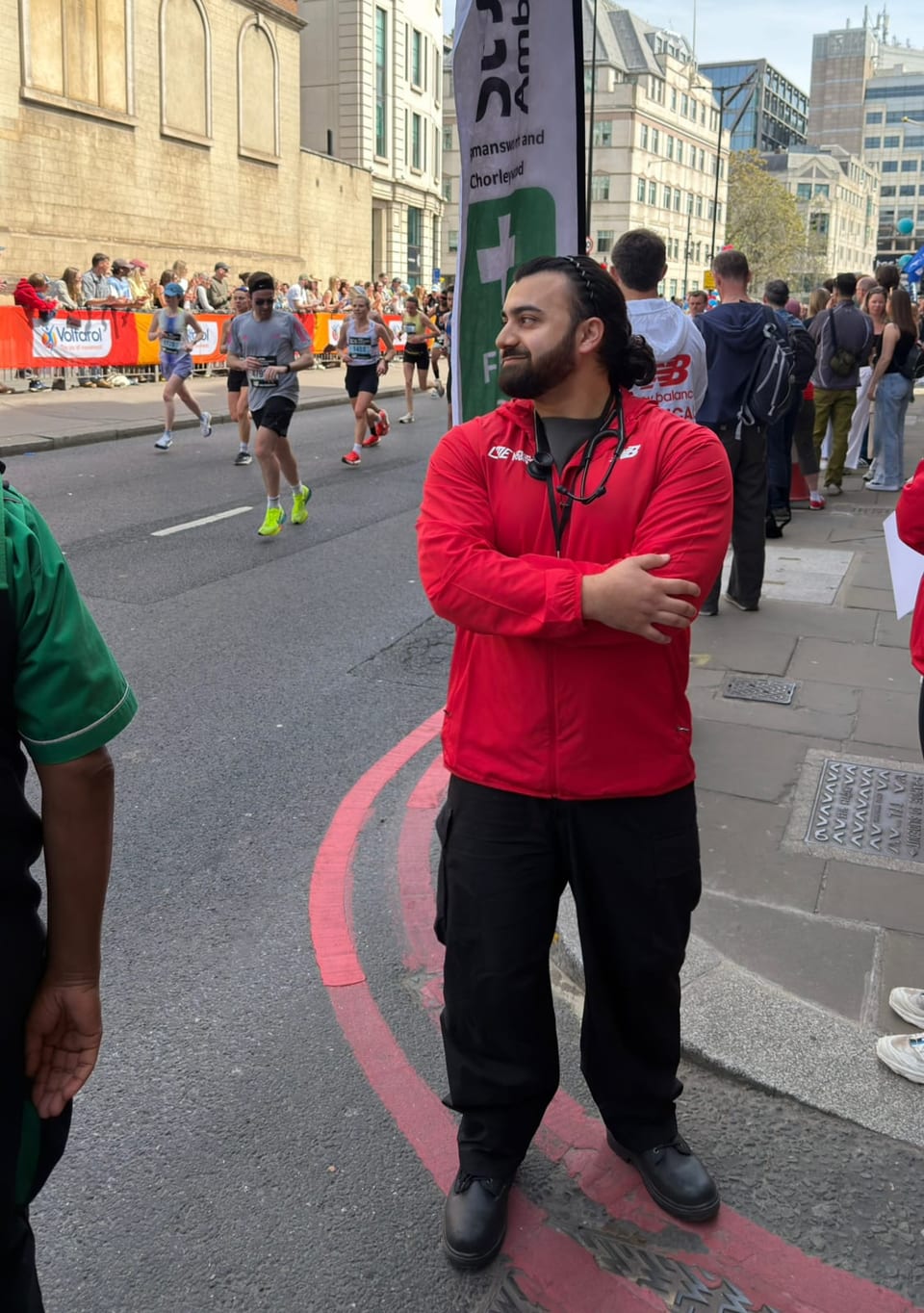
LME allocate you to a medical station along the course. Most stations are run in liaison with St John Ambulance (SJA), so you work as an LME doctor embedded within an SJA medical team as temporary staff. The largest medical presence is at the finish line, which is where the majority of collapses and emergencies are picked up as runners push through their symptoms to cross the line.
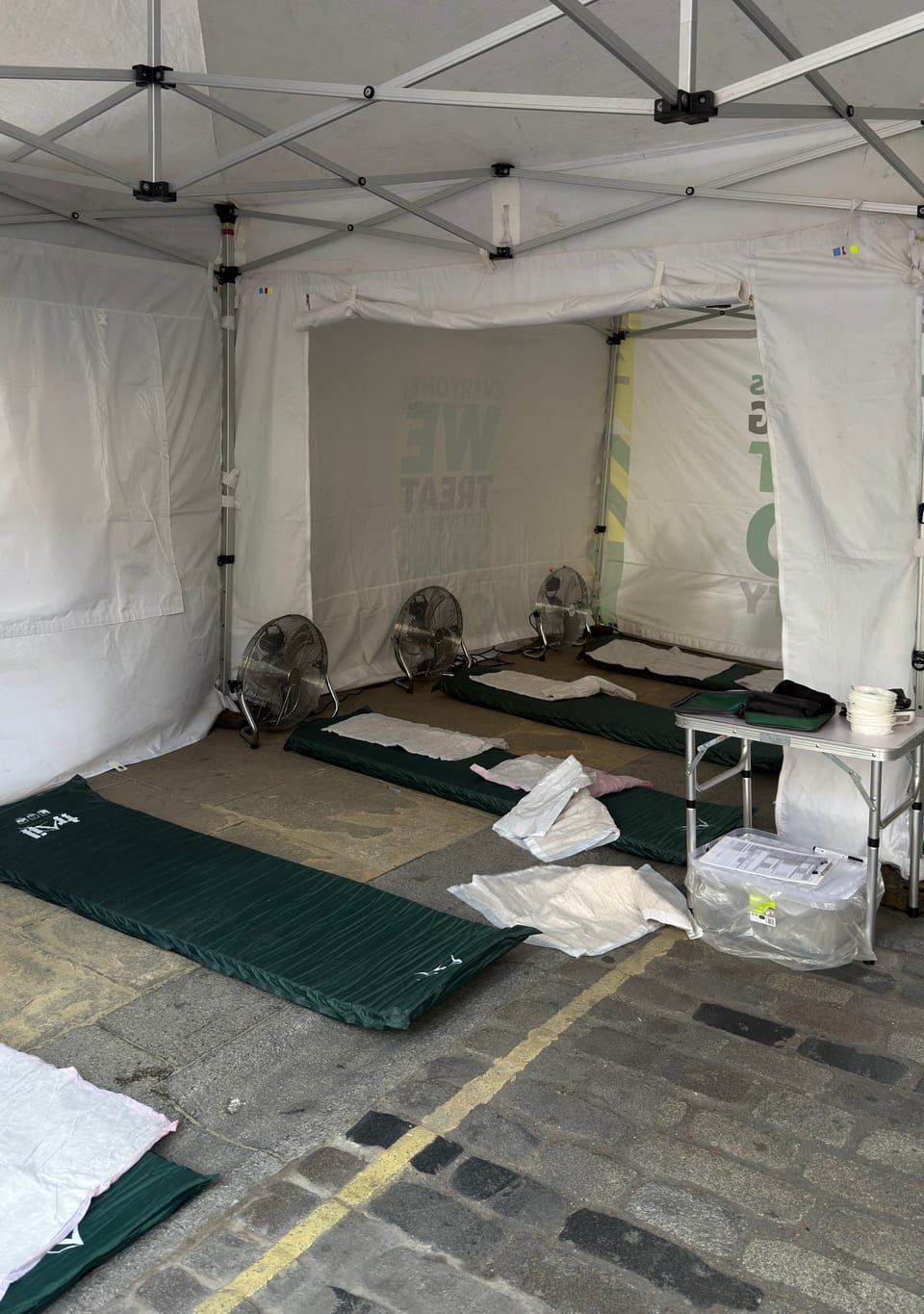
I was stationed at mile 23. The setup consisted of SJA tents integrated into a side street just off the main course road. Inside, there was a majors area, a minors area, and a dedicated section for ice water immersion for exertional heat illness (EHI). There are also patrol vehicles along the course, mainly crewed by paramedics, and a mobile HEMS unit, but most doctors are posted to a fixed medical tent and stay there for the duration.
What the day looks like
I arrived at 08:30. The first couple of hours are preparation: briefing, helping set up, familiarising yourself with protocols and equipment, and running rehearsals. We practised the EHI pathway end to end. If a patient presents with suspected exertional heat illness, they are placed into a tarpaulin body bag, zipped up, and have ice and cold water poured in to rapidly cool them while heart rate and core temperature are monitored continuously. You want that process to be automatic before the first real patient arrives.
Then you wait.
The elite wheelchair race comes through first. Then the elite men, including Sabastian Sawe, who broke the world record with a time of 1:59:30, becoming the first person to run a sub-two-hour marathon under record-legal conditions. Then the elite women. At that point, you are mostly watching and absorbing the atmosphere.
Sawe's 1:59:30 on 26 April 2026 took the world record from Kelvin Kiptum's 2:00:35, set in Chicago in October 2023. Yomif Kejelcha was second in 1:59:41, also inside two hours. Eliud Kipchoge's 1:59:40 in Vienna in 2019 was a staged exhibition with rotating pacemakers and was never ratified as a record. Source: Olympics.com, Sabastian Sawe 2026 London Marathon breakdown.
The busiest period hits when the advanced non-elite runners come through. These are the club runners and competitive amateurs who push themselves hard, often trying to maintain a pace closer to the elite field than their bodies can sustain. This is when collapses start. For a good 2-3 hours around the middle of the day, patients flood the medical tent. It is relentless.
The afternoon gradually quietens as the more recreational runners pass through at a slower pace, many walking by this stage. My station wrapped up at 19:15, once the last runners had cleared the section. That is a long day on your feet.
We had a designated hotel a two-minute walk from the tent for toilet breaks and hot drinks, which made a significant difference.
What you actually see and treat
The most common presentation by far was exertional heat illness. The 2026 race was more forgiving than the previous year in terms of temperature, but EHI still dominated. After that, collapse for other reasons: hypoglycaemia, confusion potentially related to exercise-associated hyponatraemia from overhydration (this has improved in recent years thanks to campaigns educating runners to drink to thirst rather than overhydrating), and exercise-associated postural hypotension, particularly at the finish line, where runners stop suddenly and the loss of the muscle pump causes syncope or pre-syncope from reduced venous return.
There were also plenty of musculoskeletal presentations: non-resolving cramps, lower limb pain from pre-existing injuries flaring under marathon load, and the general wear of 26.2 miles on undertrained bodies. And then the miscellaneous: runners with gastrointestinal symptoms, people who had started the race with a fever or illness and were now paying for it.
What makes it hard
The hardest part is the chaos during that 2-3 hour peak window around midday. Patients come in faster than you can process them, the tent starts to fill, and you run out of bed space. That is when clinical prioritisation becomes critical. You are triaging on the move, deciding who needs a majors bed, who can be stepped down, and who can be discharged to make room.
We had a bed manager on the logistical side, which helped enormously with patient flow. Communication between the clinical and logistical teams is what keeps the tent functioning when it gets overwhelmed.
The other challenge is working without the diagnostic toolkit you are used to. There are no blood tests. No imaging. You have vital signs machines and an ECG, and beyond that it is history, examination, and clinical judgement. If you have spent your career in emergency departments or hospital medicine, that stripped-back environment takes adjustment. It forces you to rely on fundamentals in a way that is actually quite good for your practice, but it is uncomfortable in the moment when you want to confirm a suspicion and cannot.
Is it worth it
Yes. Without hesitation.
You get a New Balance doctor jacket, free lunch and drinks throughout the day, free TfL travel if you show your staff pass, and a signed letter from the LME Medical Director thanking you for volunteering. Those are the tangible things.
The intangible things are better. The atmosphere is genuinely special. Everyone there is volunteering because they want to be. The general public and the runners are openly appreciative of your work, which is something you do not always experience in NHS hospitals under the weight of understaffing and underfunding. The networking is useful if you are interested in event medicine, pre-hospital practice, or marathon medicine more broadly. And the clinical experience is valuable in a way that is hard to replicate elsewhere: high-volume, time-pressured, resource-limited medicine in a setting where every patient walked (or ran) in healthy that morning.
If you are building an SEM portfolio, it is also concrete evidence of commitment to the specialty. A letter from the Medical Director of LME, a certificate of participation, and the ability to talk about the experience at interview. That all counts.
The 2027 2-day marathon and what it means for medical cover
It was announced this month that the 2027 TCS London Marathon will be a one-off 2-day event on Saturday 24 and Sunday 25 April, with 100,000 runners across both days. Elite women, female para-athletes, championship and good-for-age women will lead the mass event one day, with elite men, male para-athletes, championship and good-for-age men leading the mass event the other. A record 1.33 million people have already applied through the ballot.
From a medical cover perspective, this raises real questions. Doubling the number of runners across two days means two full days of medical staffing, two complete equipment setups, two cycles of consumables and ice, and the logistical challenge of resetting medical tents overnight between day one and day two. The volunteer medical workforce that covers a single day already stretches the available pool. Finding enough doctors, paramedics, nurses, and first aiders to do it all again the next morning is a significant operational challenge.
There is also the question of fatigue. Medical volunteers who work a full day on Saturday may be asked to return on Sunday. Clinical decision-making deteriorates with tiredness, and the high-acuity peak periods are exactly when you need your team sharpest. How LME and SJA manage staff rotation, rest, and volunteer capacity across both days will be one of the less visible but most important aspects of making the 2-day format work safely.
I would not be surprised if LME increases the volunteer recruitment drive substantially for 2027. If you are reading this and considering signing up, next year might be the year they need you most.
Dr Isa Waheed - Founder, StudySEM
Sign up free to keep reading
Create a free StudySEM account to read this article in full and get the weekly newsletter for UK SEM clinicians.
Sign up free + get the weekly newsletterAlready have an account? Log in
- Free account, no card
- Every gated insight
- 10 full topics, yours for life
- Weekly newsletter