14 June 2026
Why I want to become a sport and exercise medicine doctor
 Dr Muhammad UmerGuest Contributor5 min read
I was never a sporty child growing up. I just about made my high school cricket team. So you can imagine the shock to those around me when I announced my dream to pursue a career in sports medicine. At first, everyone doubted the decision and chuckled at the idea that I would be the one pitchside dealing with athletes in the midst of sporting events. That all changed when I began my academic and sports medicine journey starting with my time at university. Proving to myself that the life of a sport and exercise medicine (SEM) doctor was not just a faraway dream, but a reality that exists for any doctor with a passion. I have written this article to explore the reasons behind my career goal to become an SEM doctor, and hopefully inspire those around me to choose this rewarding and exciting specialty.
I began my first degree in Biomedical Sciences at Queen Mary University of London in 2017 and immediately fell in love with the first year Human Anatomy module that taught me the fundamentals of musculoskeletal (MSK) medicine. I did not know it yet but this led me to write my dissertation on the relationship between sleep and sporting performance. An atypical topic when considering my peers were working on projects in biochemistry, pharmacology and genetics. Yet there was something so exciting to me about learning of the extreme limits that the human body can function. To this day, the science behind record-breaking athleticism can truly be both extraordinarily complex and yet so simple. It all comes down to the cumulative effect of marginal scientific gains including tracking recovery and sleep, nutrition optimisation and using training data to manage load. We cannot forget the genetic and physiological adaptations that also allow for athletes to be superhuman too. For me, this idea that we can apply the fundamentals of science and data to help compete at record-breaking levels is exciting and far more appealing than being stuck in a purely hospital environment.
My interest in SEM accelerated during the COVID-19 pandemic when I began to join the monthly BASRAT webinars and learned more of the life of an SEM doctor. Hearing from leading experts and their contributions to their respective sports was fascinating. Whilst the physical stadium doors were closed in the midst of the pandemic, the doors to the world of SEM opened for me. The academic interest continued to grow when I came across Dr Irfan's article on the fasting athlete. As a Muslim, the holy month of Ramadan plays a crucial role for our spiritual development, but this was the first time I understood the significance of its physical demands too. It was at this moment that I realised that the field of sports medicine, especially at the elite level, has far more depth and breadth than I could have imagined. It also requires a nuance and risk management applied in ways that are not so obvious compared to what we see in other medical specialties. It was at this point in medical school that I reached out to Dr Irfan and was able to help launch The MSK Playbook whilst becoming involved in research that has been presented at multiple BASEM conferences, with more research still in the pipeline.
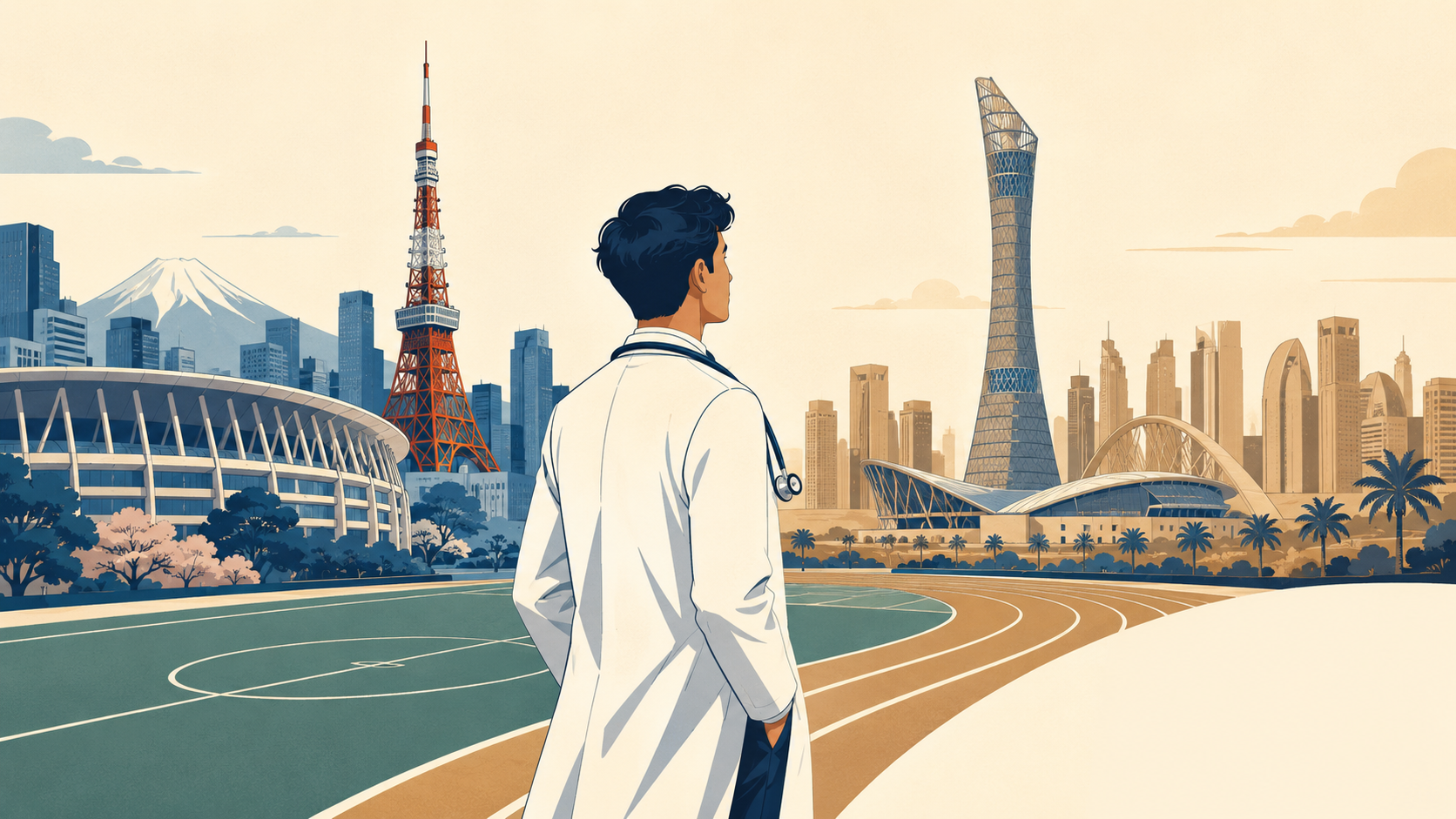
My determination to pursue a career in sports medicine accelerated in 2025 when I was able to attend Jikei University Hospital in Tokyo, Japan for my elective as part of the King's College London Twin Links Programme and through the Undergraduate Elective Bursary Award by the British Association of Sport and Exercise Medicine (BASEM). I was not only exposed to international sports medicine and orthopaedics but I also found myself understanding the often forgotten benefits of the exercise part of SEM. In the country with the longest average life expectancy, I was surrounded by the elderly who were fitter and far more disciplined in their approach to physical health than what I saw across the UK. On my last day, I paid a visit to the Olympic Museum next to the National Stadium and began to feel the legacy that international sports can play on the health of the nation. It was inspiring and refreshing as it brought me to realise that I was not just pursuing a specialty, but rather a way of life that could make all the difference.
In the second half of my elective I was honoured to spend time at Aspetar in Doha, Qatar. As someone who has a keen interest in football medicine, this was an opportunity of a lifetime to spend time at a FIFA Centre of Excellence. The athlete clinics and MSK clinics that I shadowed provided a real opportunity to understand what goes on behind closed doors at the most elite level. Despite being a part of London Spirit in the 2022 edition of The Hundred cricket tournament (more on that in a future blog), my time at Aspetar showed me what can be achieved at the highest level of SEM. Each member of staff played their role from consultation to treatment, whether it was surgical or medical, to rehabilitation which put the athlete at the heart of the job. I was speechless at the world-class facilities and the level of detail that is required in the background to ensure optimal performance can be achieved. Although this intensity and level of detail-driven work can put others off, it only inspired me to learn more and take on studying for the FIFA Football Medicine Diploma.
This specialty is not what you think. It is not just a matter of managing MSK conditions or spending time with players and setting expectations for managers. It is a truly holistic specialty that requires understanding of the human body and how to safely handle its performance when under physical and psychological pressure. It is not just about the athlete going for the world record as many people think. It is about the mother of three who wants to get back into running again. It is about the grandfather with knee problems who wants to play football with his friends. It is about allowing physical movement to take place in a healthy and comfortable manner that enables us to socialise, better our health and prove to ourselves that we can achieve more than what we set our minds to. My journey from university student to resident doctor has taken me across the world and exposed me to various specialties. Yet I cannot think of another career to pursue with such passion. Although I am at the early stages of my career as a doctor, I am determined that one day I will find myself in the position to call myself an SEM trainee and consultant. Until then, I will remain curious and determined to leave my mark on the specialty that keeps inspiring me to become better.